
If you’ve ever felt stuck in the same emotional patterns—anxiety that won’t quiet down, depressive thoughts that sneak in before you even notice—you’re not alone. For years, I thought something was wrong with me because I couldn’t “just snap out of it.” I’d start strong, fall back into old habits, and feel defeated all over again.
But here’s what I’ve learned: It’s not a character flaw. It’s a brain pattern. And patterns can be changed.
Thanks to the last 15 years of neuroscience, we now know the brain is rewire able. Not in big dramatic leaps, but through small, consistent steps that shift the way our brain fires. That’s what this guide is about—how I’m learning to create upward spirals instead of downward ones.
This isn’t theory. It’s practical, doable, and grounded in how the brain actually works.
Why Depression Feels So Hard to Escape
Depression and anxiety don’t show up the same way for everyone. Some people feel it as heaviness. Others feel it as numbness, irritability, or constant self criticism. Some have a long family history. Others have lived through trauma or chronic stress. Some have been treated before and fear slipping back.
But underneath all those differences, neuroscience shows something consistent: Depression is a pattern of brain activation. And patterns can be interrupted.
For years, we believed the brain was fixed—whatever wiring you had was the wiring you were stuck with. Now we know the opposite is true. The brain is constantly reshaping itself based on what we do, think, and practice.
That’s the hope behind this whole process.
The Science Behind Change (In Simple Language)
Here’s the short version of what the research shows:
1. The brain changes through repetition
- Small actions repeated over time literally reshape neural pathways.
2. Intention activates the prefrontal cortex
- When I set a clear intention—“This is what I want to change”—my brain becomes more open to learning.
3. Naming fears calms the limbic system
- The limbic system is the emotional center of the brain. When I name what I’m afraid of, it quiets down enough for me to move forward.
4. Sharing with someone integrates the brain
- When I talk to a safe person about what I want and what I fear, the emotional and rational parts of my brain begin working together.
These aren’t inspirational ideas—they’re neurological realities.
How I’m Beginning My Upward Spiral
Here’s the simple, practical process I’m using to start rewiring my brain. You can use it too.
1. I Start by Naming What I Want to Change
Instead of vague hopes like “I want to feel better,” I ask myself: “What do I want to experience on the other side of this?”
Maybe it’s:
- more energy
- fewer spiraling thoughts
- the ability to enjoy things again
- better focus
- more emotional stability
Setting intention isn’t fluff. It wakes up the prefrontal cortex—the part of the brain responsible for planning, motivation, and change.
It’s like telling your brain, “Pay attention. Something new is happening.”
2. I Name the Fears That Usually Hold Me Back
This part surprised me.
When I write down the obstacles— “I’m afraid I’ll fail again.” “I don’t have time.” “I lose motivation.” “I don’t trust myself to follow through.” —something shifts.
Neuroscience shows that naming fears reduces limbic activation. In plain language: Naming fear lowers fear.
It doesn’t remove it, but it takes away its power to freeze me.
3. I Share My Goal With One Safe Person
This step is uncomfortable for many of us, especially if shame or past hurt makes vulnerability feel risky. But here’s why it matters: When I share my goal and my fears with someone supportive, the emotional part of my brain (limbic system) and the rational part (prefrontal cortex) begin working together.
That integration is what makes change sustainable.
If you don’t have someone safe to share with, journaling has a similar effect. The key is getting the thoughts out of your head and into the world.
Why Small Steps Matter More Than Big Ones
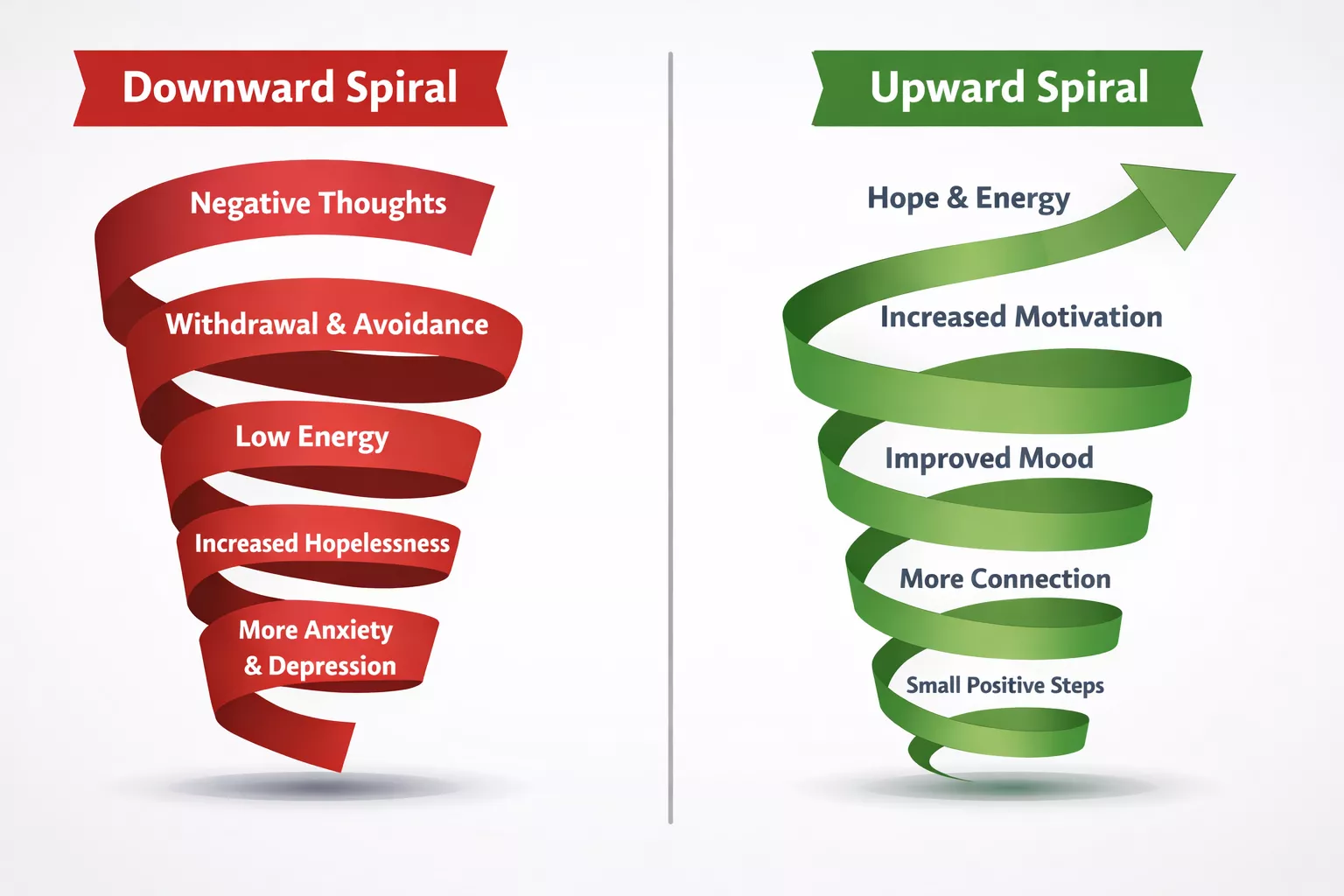
The whole point of this process is to create upward spirals—small, positive shifts that build on each other.
Depression creates downward spirals:
- low energy → less activity → more hopelessness
- negative thoughts → withdrawal → more negative thoughts
- stress → avoidance → more stress
But upward spirals work the same way in reverse:
- one small action → a little more energy
- a moment of connection → a little more motivation
- naming a fear → a little more calm
The brain doesn’t need big leaps. It needs small, repeated signals that say: “We’re moving in a new direction now.”
What I’m Learning About My Brain (And Maybe Yours Too)
Here are the truths I’m holding onto as I walk this out:
1. My brain is not stuck
- Neuroplasticity means it can change at any age.
2. My patterns are understandable—not shameful
- They were shaped by genetics, stress, trauma, or survival.
3. Change doesn’t start with motivation.
- It starts with tiny actions that create motivation.
4. I don’t have to do this alone.
- Connection is part of the healing process.
5. Small steps are not small.
- They are the building blocks of upward spirals.
Get started today “wiring” an upward spiral using the three-step process described above in How I’m Beginning My Upward Spiral – and don’t forget to share it with someone.
If you’d like more personal help, contact us by email or call to set up a free 15-minute phone consultation to discuss your specific challenges and explore how we can help.